The Great Migration: Where to Be and When — A Month-by-Month Guide
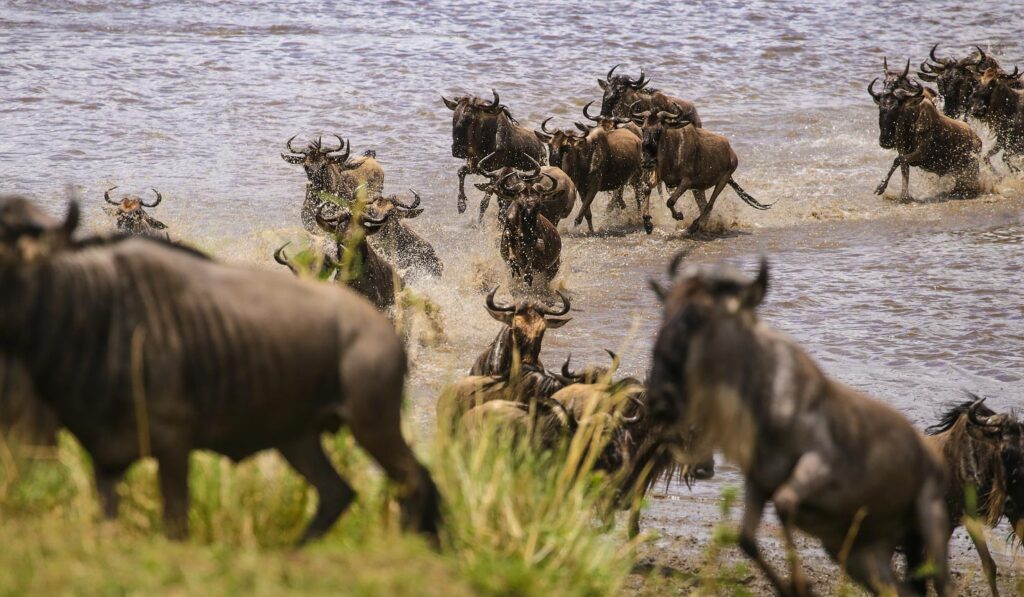
Imagine standing at the edge of the Mara River in the early morning light. The air hums. The earth trembles — softly at first, then with a deep, ancestral rumble. And then you see them: hundreds of thousands of wildebeest, muscle and horn and wild instinct, plunging into churning water, surging toward the opposite bank. Crocodiles wait. The chaos is absolute. And it is one of the most magnificent things a human being can witness.
This is the Great Migration — the greatest wildlife spectacle on the planet. Every year, roughly 1.5 million wildebeest, joined by hundreds of thousands of zebras and gazelles, make a 1,800-mile circular journey through the Serengeti ecosystem in Tanzania and the Masai Mara in Kenya. And if you’re planning to witness it in 2026, timing is everything.
Understanding the Great Migration
The migration is driven not by a fixed schedule, but by rainfall, grass, and the ancient wisdom of the herd. The wildebeest follow the rains, moving clockwise through the ecosystem in search of fresh pasture. As a traveller, your job is simply to position yourself at the right place at the right time.
Here is your definitive month-by-month guide for the Great Migration, written from the experience of those who have walked this land and watched the skies.
January – March: Calving Season in the Southern Serengeti
January opens in the Southern Serengeti and Ndutu region with what many call the most tender chapter of the migration story: calving season. Around 500,000 wildebeest calves are born within a matter of weeks — a biological strategy called synchronised calving, designed to overwhelm predators through sheer numbers.
The short green grass of Ndutu is a photographer’s paradise. Lion prides are hyperactive. Cheetahs stalk at dawn. Hyenas gather at the edges. And amid the golden plains, you will witness new life arriving in its most vulnerable, most beautiful form. Calving season runs from late January through February, making these two months the best time to visit the Serengeti for those seeking emotional, story-rich wildlife encounters.
Best for: Families, photographers, and first-time safari-goers. Accommodation in Ndutu fills fast — book your 2026 camp at least 12 months in advance.
April – May: The Green Season and Hidden Serengeti
April and May bring the long rains to the Serengeti. The herds have begun their northward push through the Western Corridor. The landscape turns luminous green, birdlife explodes into colour, and the parks thin of visitors. This is the secret season — quieter, more affordable, and strangely magical.
Some roads become impassable, and river crossings are not yet at their peak drama. But for those who love the intimacy of an uncrowded Serengeti, the long rains offer an Africa that feels entirely your own.
June: The Western Corridor and Grumeti River Crossings
By June, the herds mass in the Western Corridor, and a preview of the drama to come begins. The Grumeti River — home to enormous, ancient crocodiles — sees its first major crossings of the 2026 season. The tension here is quieter than the Mara River crossings but no less primal. June is the beginning of peak safari season; book early.
July – August: The Mara River — River Crossings at Their Peak
This is it. The moment. The Serengeti migration calendar builds all year toward July and August, when the wildebeest mass at the Mara River in their hundreds of thousands and attempt the crossing into Kenya’s Masai Mara.
Nothing prepares you for it. The herd builds for hours — circling, retreating, circling again — before a single brave animal leaps in and thousands follow. The crocodiles surge. The water turns. Within minutes, the crossing is over. Some make it. Not all do. And the savanna absorbs it all with the indifference of an older world.
July and August are the most sought-after months for the wildebeest migration best time to visit. Premium camps on the Mara River book out 18 months ahead for 2026. Do not delay.
September – October: Lingering Drama in the Masai Mara
September extends the river crossing season into the Masai Mara, with crossings continuing at unpredictable intervals — sometimes twice a day, sometimes none for a week. The drama is less frantic but arguably more contemplative. The herds graze freely across the Mara triangle, and the big cat action — lion, leopard, cheetah — is extraordinary.
October sees the herds begin their return south. The Masai Mara migration season stretches beautifully into the shoulder of the year, offering slightly lower rates and lighter crowds than peak July-August.
November – December: Return to the Serengeti
By November, the short rains return and the migration loops southward again. The herds scatter across the central and eastern Serengeti, and the landscape breathes again. The cycle closes, and somewhere in the Southern Serengeti, the first calves of early 2027 are already stirring within their mothers.
December is a quiet, beautiful time in the Serengeti — festive for families seeking a Christmas safari, with comfortable conditions and herds moving gently through open plains.
Planning Your Great Migration 2026 Safari
The Serengeti migration calendar rewards those who plan early and choose deliberately. Here is what to keep in mind:
Book your accommodation 12–18 months in advance, especially for July and August Mara River camp spots. Work with a specialist safari operator who can track herd movement in real time and move you if needed. Choose mobile camps where possible — they follow the migration, so you do too. Combine your migration safari with a Tanzania Northern Circuit extension: Ngorongoro Crater, Tarangire, and Lake Manyara all add depth and variety.
The Great Migration 2026 is not just a trip. It is the kind of experience that rewires something in you — the kind you spend the rest of your life trying to describe to people who weren’t there.
A Final Word
There are places in this world that remind you what it felt like to be a small, wondering creature on a very large earth. The Serengeti is one of them. Plan well, arrive open-hearted, and let the migration do the rest.